
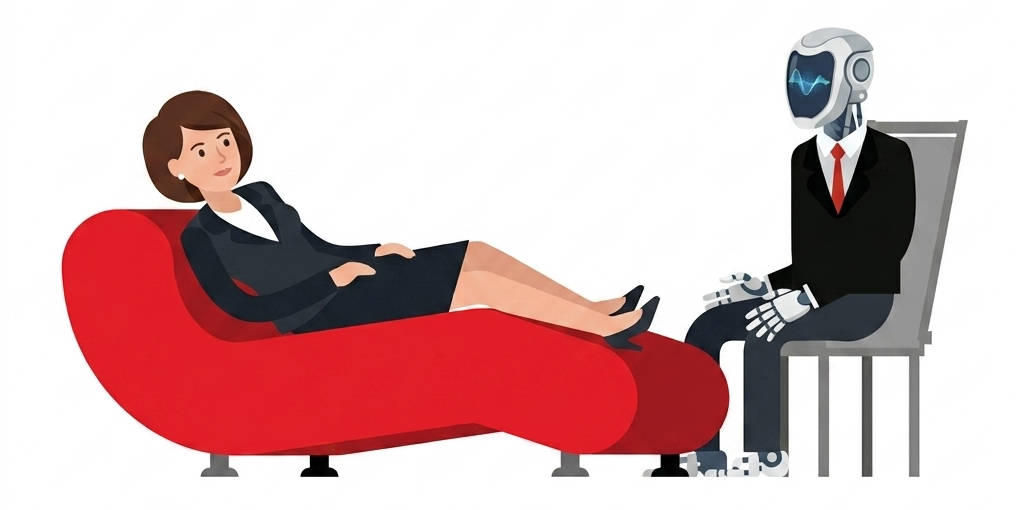
Artificial intelligence has arrived in our lives remarkably quickly. We use it to write emails, research holidays, answer questions, translate languages and increasingly, to talk about things that are much more personal. For someone feeling anxious, lonely, overwhelmed or simply unable to make sense of what is happening in their life, opening an AI chatbot can seem remarkably appealing. It is available 24 hours a day, has no waiting list, avoids the awkward first phone call, and can be accessed at little or no cost compared with seeing a psychotherapist privately.
So why would anyone still choose to sit down with a human therapist? It is a reasonable question, and the answer is not that AI is bad. AI can be genuinely useful for finding information, organising thoughts, exploring ideas and learning about psychological concepts. For someone who is nervous about seeking help, it may even be a first step towards acknowledging that something is not quite right. The more important question is whether it should replace psychotherapy. The evidence and the professional concerns emerging in Ireland firmly suggest that it should not.
The extraordinary appeal of AI
The attraction is obvious because a therapy session with a qualified professional costs money. Depending on the therapist and location, regular private therapy can represent a significant expense over weeks or months. AI, by comparison, can provide an apparently attentive conversation for little or no cost. It is also wonderfully convenient. You can talk to it at two o’clock in the morning without having to travel anywhere, arrange childcare or take time off work.
Because you are communicating through a screen, some people may initially find it easier to disclose things they would feel embarrassed saying to another person. While these are genuine advantages that give AI a useful supporting role in mental health, the mistake is assuming that an accessible and convincing tool is equivalent to professional psychotherapy.
Therapy is more than receiving a good answer
A chatbot can produce an extraordinarily empathetic-sounding response, but psychotherapy is not simply a sophisticated question and answer exercise. A psychotherapist is listening to much more than the words being typed or spoken. They notice changes in tone, hesitation, contradictions, avoidance, emotional reactions and patterns that may emerge over several sessions. Sometimes a pause says more than a paragraph, and a person’s words might say one thing while their expression or posture reveals something quite different.
By catching these subtle human cues, professionals develop a deep understanding of the individual sitting in front of them, including their history, relationships, personality, circumstances and ways of coping. Perhaps most importantly, a therapist does not have to agree with you. Sometimes the most therapeutic response is a gentle challenge, pointing out an unrecognised pattern, or sitting with something uncomfortable rather than immediately trying to offer reassurance. Research has repeatedly found an association between the quality of the therapeutic alliance and better treatment outcomes.
What happens when AI gets it wrong?
There is another problem that deserves considerably more attention, which is that AI can confidently give incorrect information. Generative AI systems can “hallucinate”, producing information that sounds plausible but is simply wrong. They do not necessarily know when they make an error, and a fluent, confident answer can make a mistake surprisingly difficult to recognise. This matters immensely when discussing mental health.
While an incorrect answer about a restaurant is inconvenient, a flawed interpretation of someone’s psychological state can be much more serious. An AI system might misunderstand what someone is experiencing, provide inappropriate advice, reinforce an unhealthy interpretation of events or fail to recognise that a situation requires professional assessment. This concern becomes particularly acute when someone is experiencing suicidal thoughts, severe depression, paranoia, delusions or other significant mental health difficulties, and research into AI mental health systems has identified concerning failures in precisely these areas.
This is not simply an overseas concern. In March 2026, three major Irish professional bodies, the IACP, the Psychological Society of Ireland and the College of Psychiatrists of Ireland, issued a joint statement calling for a ban on AI “therapy” in Ireland. They specifically warned about the possibility of AI reinforcing delusional or paranoid beliefs and highlighted the absence of the clinical judgement and ethical accountability expected of a human professional. Their position is striking because it does not amount to a rejection of artificial intelligence itself. The statement acknowledges that AI may offer useful tools for wellbeing while drawing a firm distinction between using technology to support mental health and presenting an AI system as a substitute for a qualified professional.
A therapist has something AI does not
There is an important difference between being responsive and being responsible. An AI system can respond to what you tell it, but a psychotherapist has professional responsibilities towards the person they are treating. A therapist can recognise when something is outside their expertise and change their approach when a particular intervention is not working. Crucially, a professionally trained therapist working within an established professional and ethical framework can identify concerns that warrant further assessment and recommend that someone consult their GP or another healthcare professional when necessary.
There is also a question of privacy. People may disclose extraordinarily personal information to an AI system without fully considering where that information is stored, how it is processed or what data protections apply. With something as intimate as psychotherapy, that is not a trivial consideration.
AI doesn’t have to be the enemy
None of this means we should be frightened of AI or pretend that it has no place in mental healthcare. The technology is developing rapidly, and there may be valuable applications. AI could potentially help people access reliable psychoeducation, support therapeutic exercises between sessions, assist professionals with administrative tasks or make certain forms of support more accessible. Ireland is already developing its approach to responsible AI within the framework of the EU AI Act, which aims to protect health, safety and fundamental rights while promoting human-centred and trustworthy artificial intelligence.
The more sensible question, therefore, may not be a strict choice between AI or therapy. It may be asking how we can use AI without losing what makes therapy work. For someone with mild difficulties who simply wants information or a way of organising their thoughts, an AI chatbot may sometimes be useful. However, when someone is struggling with persistent anxiety, depression, trauma, relationship difficulties, grief or more serious psychological distress, there is considerable value in talking to another human being who has been professionally trained to listen, understand, challenge and support.
The human element still matters
Perhaps the greatest irony of AI therapy is that its greatest strength can also be its greatest weakness. While a machine will never look bored, will not interrupt, and can produce an articulate response within seconds, human therapy was never supposed to be about finding an entity that always gives us exactly the response we want.
Authentic therapy involves being genuinely understood by another person and developing a secure relationship where difficult things can be explored safely. It is a collaborative space for discovering patterns, confronting uncomfortable truths, and gradually developing different ways of understanding ourselves and relating to other people. Although AI may become an increasingly useful part of that process, replacing the human therapist altogether is a very different proposition. For now, the strongest argument for psychotherapy may be surprisingly simple. We are human beings, and sometimes what we need most is another human being.